Client
OliveNation is a US e-commerce brand specialising in premium flavoring extracts, spices, and culinary ingredients. Trusted by culinary professionals, food service operators, and home cooks alike, the brand operates a wide, deep catalogue — dozens of extract varieties, specialty spices, and hard-to-find culinary components — in a category where search intent alignment and precise product visibility are decisive competitive advantages. OliveNation has been a WeAdU client since 2018.
Challenge
The brief was deceptively simple: keep paid media performance high across a volatile product catalogue without inflating the budget year after year. The real complexity lay in the nature of the business. The client's category is characterised by relatively flat demand across the year — approximately 54.00% of annual revenue already reached by mid-July — a wide, heterogeneous SKU range with varying margin profiles, and a competitive landscape where any wasted impression is a missed conversion. The business needed a structure that would not just perform in year one but would sustain that performance at scale — and even improve it — across multiple years and through platform algorithm changes. Hypergrowth was not the objective. Compounding, durable efficiency was.
Approach
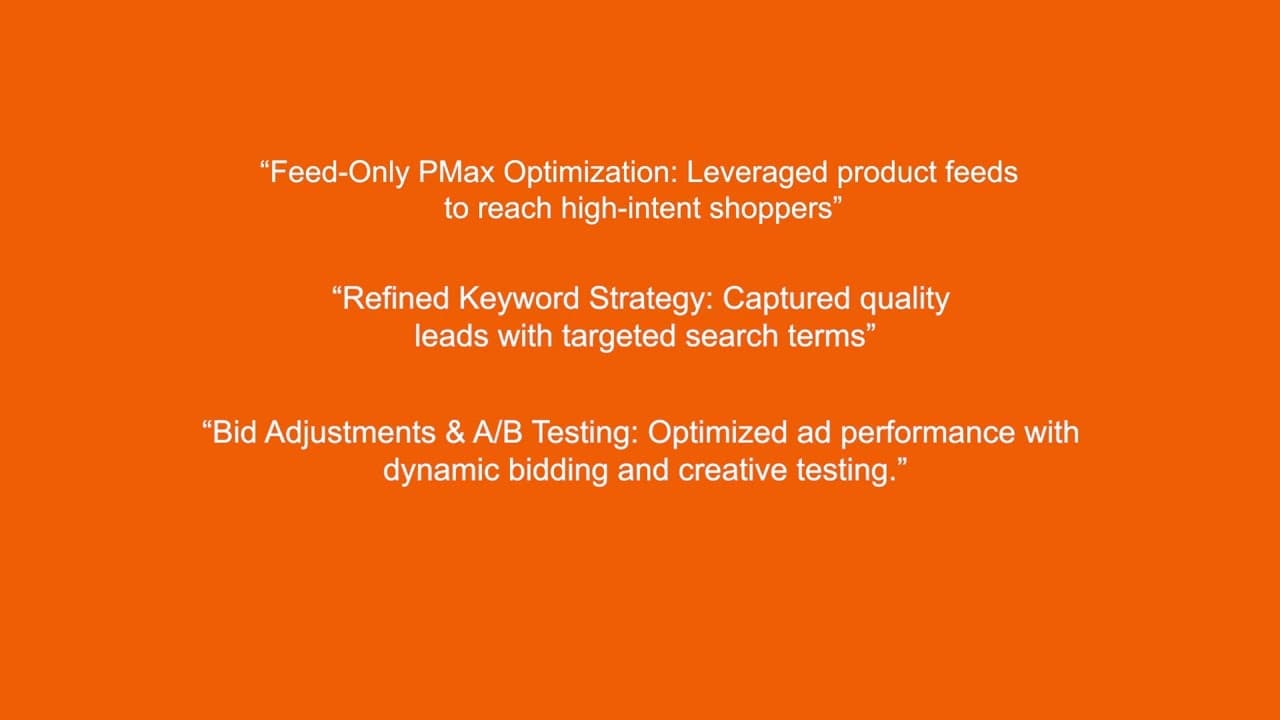
WeAdU applied its Refine → Test → Automate → Scale methodology across the full account lifecycle. The architecture was built around performance-based segmentation from the outset: Shopping campaigns structured by product category, brand affinity, and margin tier rather than by Google's default groupings. Custom labels were refreshed daily, automatically reclassifying every SKU according to current conversion velocity and price band — so high performers received appropriate budget priority, and slow movers were isolated rather than draining shared campaign efficiency.
Negative keyword architecture was built systematically and maintained continuously: blocking irrelevant or low-intent queries without suppressing legitimate demand signals. This discipline prevented the gradual quality dilution that erodes ROAS in accounts left to auto-optimise. Operator control was held throughout — no budget reallocation delegated to machine-learning systems, no broad-match experiments running unchecked. Each optimisation was deliberate, documented, and traceable.
As OliveNation's catalogue evolved, the campaign structure evolved with it — daily. That operational discipline is the foundation of every result below.
Results
Six full years of real account data — plus 2026 in progress — tell a story of exceptional and sustained performance:
| Year | ROAS |
|---|---|
| 2020 | 6.70× |
| 2021 | 7.50× |
| 2022 | 7.10× |
| 2023 | 7.09× |
| 2024 | 7.49× |
| 2025 | 7.20× |
| 2026* | 6.69× YTD |
*2026 figures as of mid-July 2026 (partial year).
Across six full years (2020–2025) plus 2026 in progress, the account has held an average ROAS of 7.11× overall — 7.18× across the six complete years. The best year is 2021 at 7.50×; 2024 closed at 7.49×. 2025 closed at 7.20×. By mid-July 2026 the account was tracking at 6.69×.
This is not the story of a single winning campaign or a lucky algorithm update. It is evidence that a disciplined, operator-controlled paid media architecture — one that treats every SKU, every day, and every dollar as a deliberate decision — produces returns that are not only high but durable. At WeAdU, we don't hand the account to Google. We run Google.